What Interviewers Really Look for in a Technical Candidate
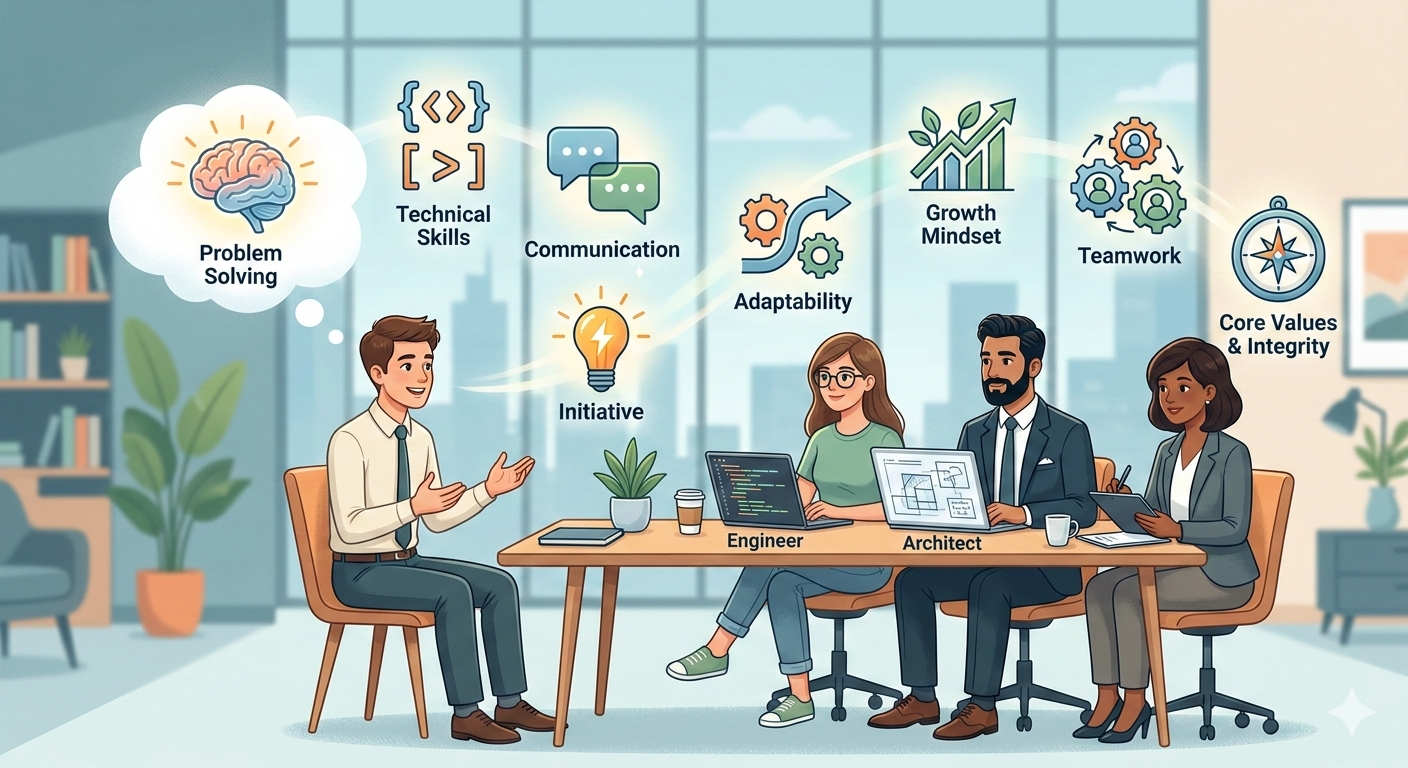
In a technical interview, your coding skills matter — but they are not the only thing that matters.
Interviewers are not just hiring someone who can write code. They are hiring someone they can work with every day, someone who can solve real problems, adapt to change, and contribute to the business.
You may be interviewed by architects, engineers, managers, and even bar raisers. Each of them is looking at you from a slightly different angle. Understanding what they seek can significantly improve your chances.
Let’s break it down.
1. Determination and Perseverance: Can You Figure Things Out?
In real projects, no one gives you a perfect recipe.
Requirements change. Documentation is incomplete. Bugs are unpredictable.
Interviewers want to see:
- Do you give up quickly?
- Or do you stay with the problem until you find clarity?
Example
Instead of saying:
“I solved a complex performance issue.”
Say:
“We had an API timing out in production. There was no clear root cause. I started by adding logging, then profiled database queries, and eventually discovered a missing index causing full table scans. After adding the index and refactoring one heavy query, response time dropped by 70%.”
The difference? You showed process, persistence, and ownership.
2. Your Approach Matters More Than the Answer
There is rarely one correct solution in engineering.
Interviewers care about:
- How you break down problems
- How you think
- How you evaluate trade-offs
They are listening to your reasoning.
If you get stuck, they want to see how you react:
- Do you panic?
- Or do you structure your thinking?
Even if your final solution is not perfect, a strong approach shows maturity.
3. Adaptability: Technology Will Keep Changing
Five years ago, certain frameworks were dominant. Today, new tools and architectures exist.
Interviewers ask themselves:
- Can this person adapt?
- Are they open to learning new techniques?
- Or are they stuck in one stack?
What They Want to Hear
Not:
“I only work with X technology.”
But:
“I worked primarily with X, but when our team adopted Y, I took an online course, built a small prototype, and helped migrate a feature.”
That shows growth mindset.

4. Yes — You Still Need to Code
Even senior candidates are expected to code.
Architectural thinking is important. Leadership is important. But you must still be hands-on.
Interviewers may test:
- Coding fundamentals
- System design thinking
- Debugging approach
Being “too high level” without execution ability is a red flag.
5. Can You Work Independently?
A strong candidate:
- Does not wait for step-by-step instructions
- Does not lean on others for basic guidance
- Can research solutions independently
Interviewers often test this subtly.
They might ask:
“How did you learn that new system?”
A good answer:
“There was no formal documentation. I read the source code, explored logs, and built small test cases to understand the behavior.”
This shows ownership and self-driven learning.
6. Communication: Tech to Tech and Tech to Non-Tech
You may talk to:
- Engineers
- Architects
- Product managers
- Business stakeholders
Interviewers are checking:
- Can you explain complex ideas simply?
- Can you adjust your language depending on the audience?
Example
Tech explanation:
“We improved system resilience by introducing circuit breakers.”
Business explanation:
“We reduced customer-facing outages by preventing cascading failures.”
Same idea. Different audience.

7. Think Beyond Code — Think Business
A common mistake is focusing only on technical excellence.
But companies ship products for customers.
Interviewers want to see:
- Do you think about user experience?
- Do you understand business impact?
- Can you prioritize value over perfection?
For example:
“We initially planned a complete refactor. But since customers needed the feature urgently, we delivered a stable incremental version first, then improved it in phases.”
That shows maturity.
8. Shipping Matters More Than Ideas
Ideas are unrealized until someone uses them.
Interviewers look for people who:
- Push work out the door
- Deliver usable solutions
- Close loops
If you started an initiative, explain how you completed it.
Not:
“I proposed a monitoring system.”
But:
“I proposed and implemented a basic monitoring dashboard, onboarded the team, and reduced incident resolution time by 30%.”
Execution is powerful.
9. Self-Motivation and Initiative
Are you someone who waits for direction?
Or someone who brings ideas?
Interviewers might ask:
“What do you do in your spare time?”
They want to understand:
- Do you experiment?
- Do you contribute to internal improvements?
- Do you stay curious?
You do not need side projects. But showing curiosity and initiative matters.
10. Stories Matter — Not Claims
Avoid vague statements like:
- “I solved a big issue.”
- “I helped two teammates.”
Instead, use structured storytelling:
- What was the problem?
- What constraints existed?
- What actions did you take?
- What was the result?
- What did you learn?
Clear stories show credibility.
11. Embody the Company’s Values
Before the interview:
- Read the company’s principles and values.
- Reflect on your experiences that align with them.
If a company values ownership, innovation, or customer obsession, prepare real examples.
Candidates who naturally embody company values are easier to hire. Skills can be improved. Values are harder to change.
12. Behavior Matters More Than You Think
Technical interviews also test personality fit.
Interviewers are asking themselves:
“Can I sit next to this person for 10 hours a day?”
Simple but important:
- Appear neat and presentable
- Be well rested
- Smile and stay humble
- Do not argue defensively
- Accept constructive feedback
- Show patience
If challenged, respond calmly:
“That’s a good point. I hadn’t considered that trade-off. In that case, I would adjust the design by…”
This shows maturity and emotional intelligence.
13. Curiosity: Ask Good Questions
At the end of the interview, you will be asked:
“Do you have any questions?”
Always ask.
Good questions show:
- You are thinking long-term
- You care about impact
- You want clarity
Examples:
- “What does success look like in the first six months?”
- “What technical challenges is the team currently facing?”
- “How do you balance speed and quality?”
Curiosity signals engagement.
Final Thoughts
Technical interviews are not about perfection.
They are about:
- Problem-solving ability
- Ownership
- Communication
- Business thinking
- Adaptability
- Humility
Most importantly, interviewers look for someone they trust to solve problems independently and work well with the team.
If you remember one thing, remember this:
They are not just hiring your skills. They are hiring your mindset.
Prepare your stories. Think about impact. Stay curious. Stay humble.
And always show how you turn problems into delivered outcomes.


One Reply to “What Interviewers Really Look for in a Technical Candidate”